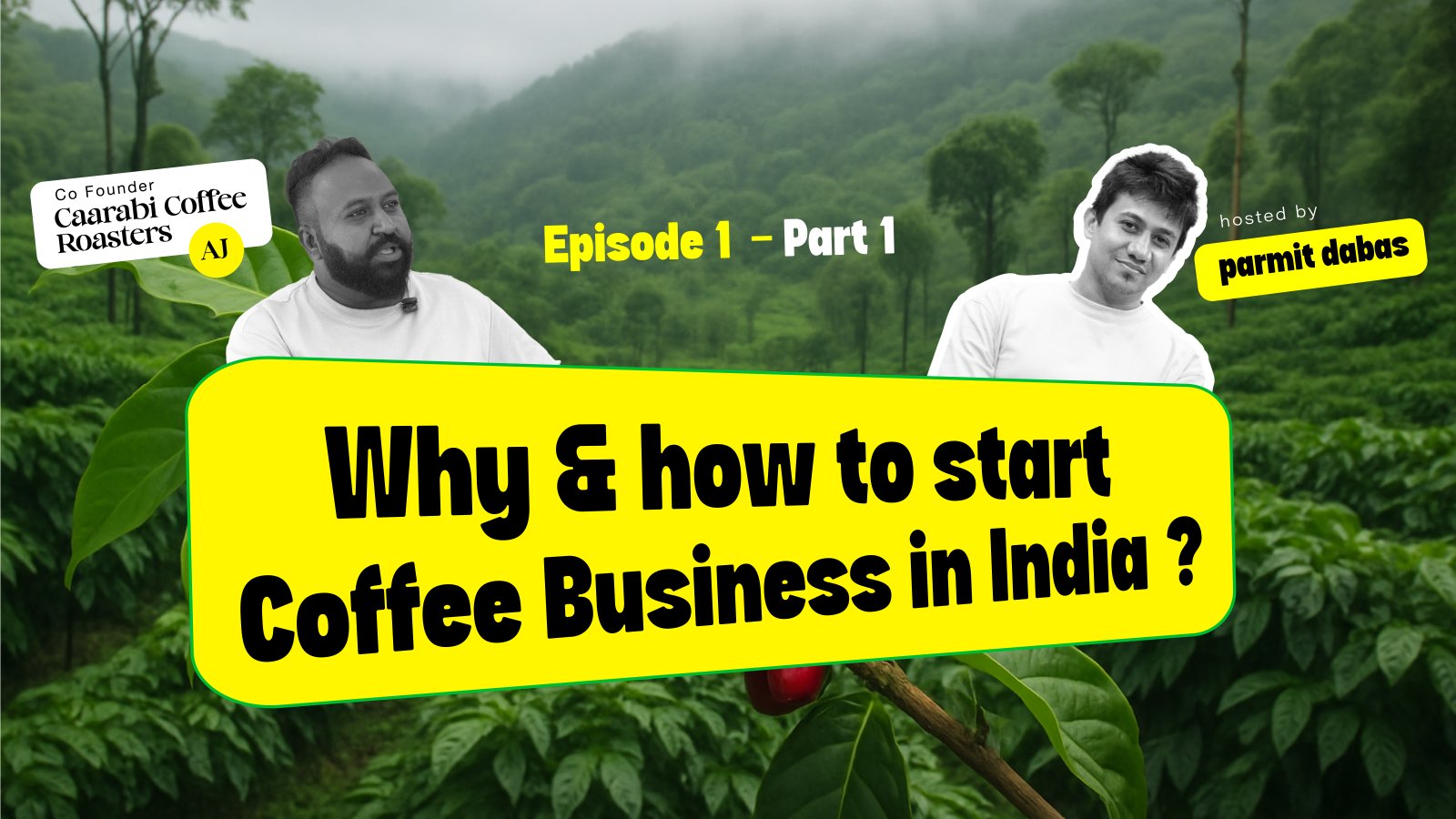
I wanted to open Spillinbean with the questions that land in my DMs more than any others. How do I become a coffee entrepreneur? Should I start a roastery or a cafe? What's the budget? I made the same jump a year ago, so I had my own version of those questions too. AJ felt like the right first guest — partly because he's hosted half our Delhi Coffee Collective meetups, and partly because his path is the least linear one I know.
Here's the punchline he opened with: he got into coffee, got out of coffee, went into corporate, then left corporate to come back to coffee. An extra loop most people don't do.
p
The background nobody sees on a label
AJ started working with coffee at 18, while he was at university. It faded in and out of his life for years. When he moved back to India, he went full-time corporate — American Express first, as a lead analyst, then other roles. But coffee never actually left. For eight or nine years it ran quietly in the background. He'd finish a shift as an analyst and turn up as a barista somewhere else. He showed up to barista championships just to watch. He volunteered at events before COVID, back when the scene was tiny and Blue Tokai had just opened one of its first cafes — right across the road, as it happens — and he'd hang around experimenting.
So when he finally jumped, it didn't feel like a leap into something new. It felt like turning up the volume on something that had been playing the whole time.
The unpopular opinion
This is the part I think people get wrong, and AJ said it plainly even though he knew it wouldn't be popular: he doesn't see corporate as the thing he escaped to find freedom. He sees it as the training that makes the freedom survivable.
A decade in corporate taught him how to structure work, how to be handed a fresh problem every single day and figure it out in real time, how to build process. The Six Sigma habits, the systems thinking, the leadership he picked up from mentors — none of it got left at the door. It crept into his workflow. And then he multiplied it by ten and pointed it at his own business.
The proof is in the scale. He went from roasting around 20 kilos a month to roughly 10,000 kilos a month. You don't survive that jump on passion. You survive it on systems — and his came pre-loaded from the years he supposedly "wasted."
What the business actually is
The tipping point for AJ was wanting a product of his own. That's what pulled him out of full-time work for good. But the business he built isn't really a bean business. He supplies B2B to 35+ cities across India — independent cafes, big chains, restaurants, hotels — and the way he frames it stuck with me: he's not trying to sell beans. He's trying to solve one problem for his clients: how do you get good, consistent coffee into your offering? The beans, he says, are almost a side effect. The real work is ideas, training, execution, helping a client hit their number so they sell more and come back.
On the market and the long game
I asked about sourcing and whether good beans are hard to get in India. Short version: India's a fairly free market with some protective tariffs, a lot of our coffee gets exported, and international beans are increasingly available if you can pay for them. But the line of his I keep repeating is about consumers, not supply. He half-joked that roasters are "drug dealers in a sense" — the more people drink, the better — and that it happens to be a good drug. He's personally watched people go from six spoons of sugar to drinking it black. That evolution is the whole business. More awareness, more consumption, more people who want the actual coffee to come through.
What I took from it
If you're sitting in a job right now wondering whether to quit and chase coffee, AJ's story isn't a clean "follow your passion" arc. It's slower and more honest than that. He kept one foot in each world for years. He let the corporate machine teach him things before he needed them. And when he jumped, it was toward a specific product and a specific problem, not just away from a desk.
So when people ask me why most folks shouldn't start a coffee business — this episode is part of my answer. Most people romanticize the exit and skip the eight years of quietly building the skill underneath it.
Listen to the full Episode 1 conversation with AJ for the bits I couldn't fit here — including the green-bean sourcing reality and the "from Jira to roasting" line.